Learning Technology
15 articles on Learning Technology.
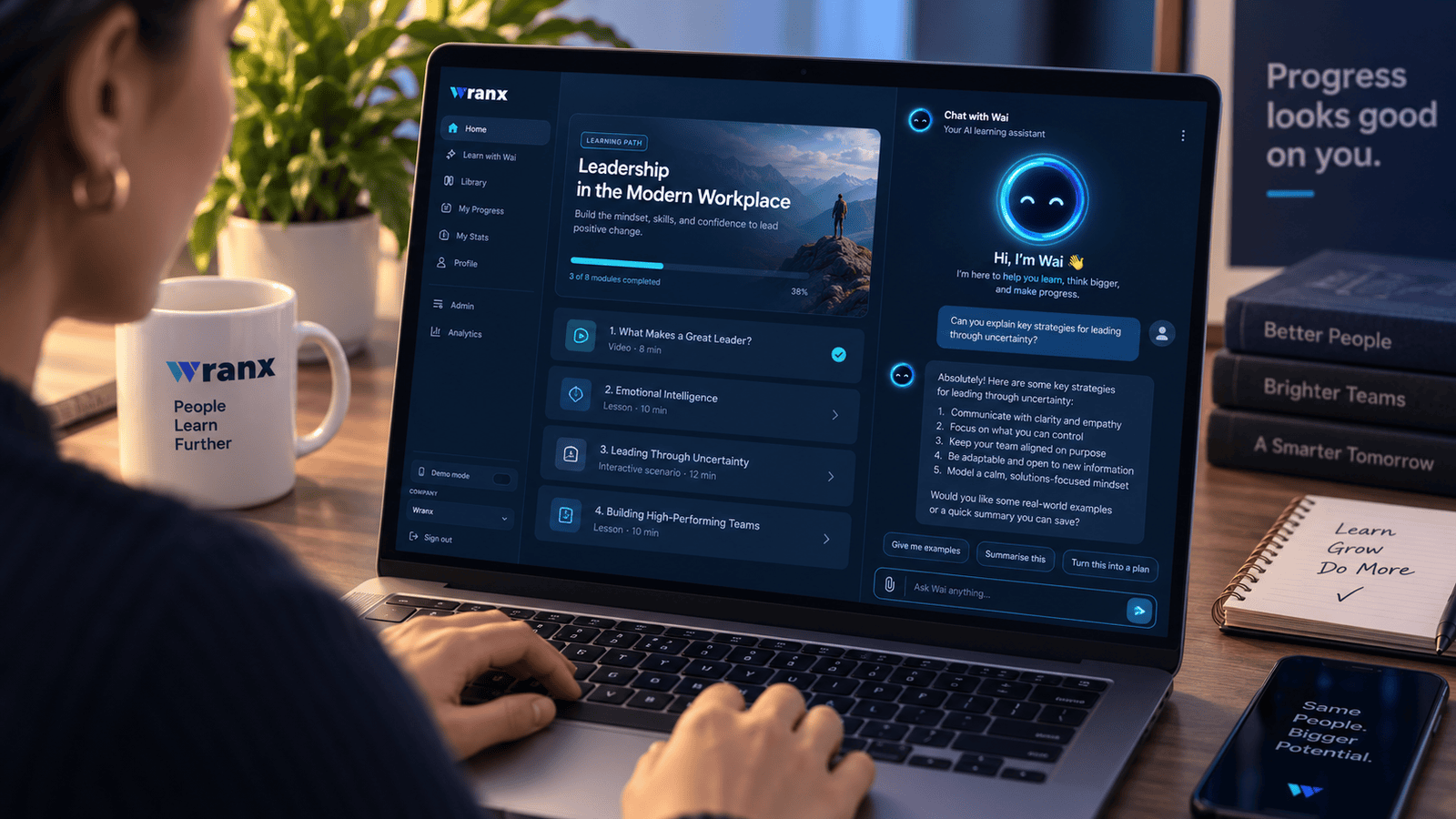
Personalised AI Learning through Wai
Wai reads what each learner has answered, spots the concepts they keep missing and builds a short plan that closes those gaps. When the learner wants to work through it, they open a Learn with Wai session and get a short lesson and a quiz for each concept, drawn from the material you have loaded.

The Policy Changed on Monday. Your Training Didn't.
Every organisation has the same lag. The document is written on Monday and the people who need it know it some time next quarter, because somebody has to turn twelve pages into questions and nobody has the week. Here is how Wranx closes that gap, and why the questions it writes have to be more than multiple choice to be worth anything.
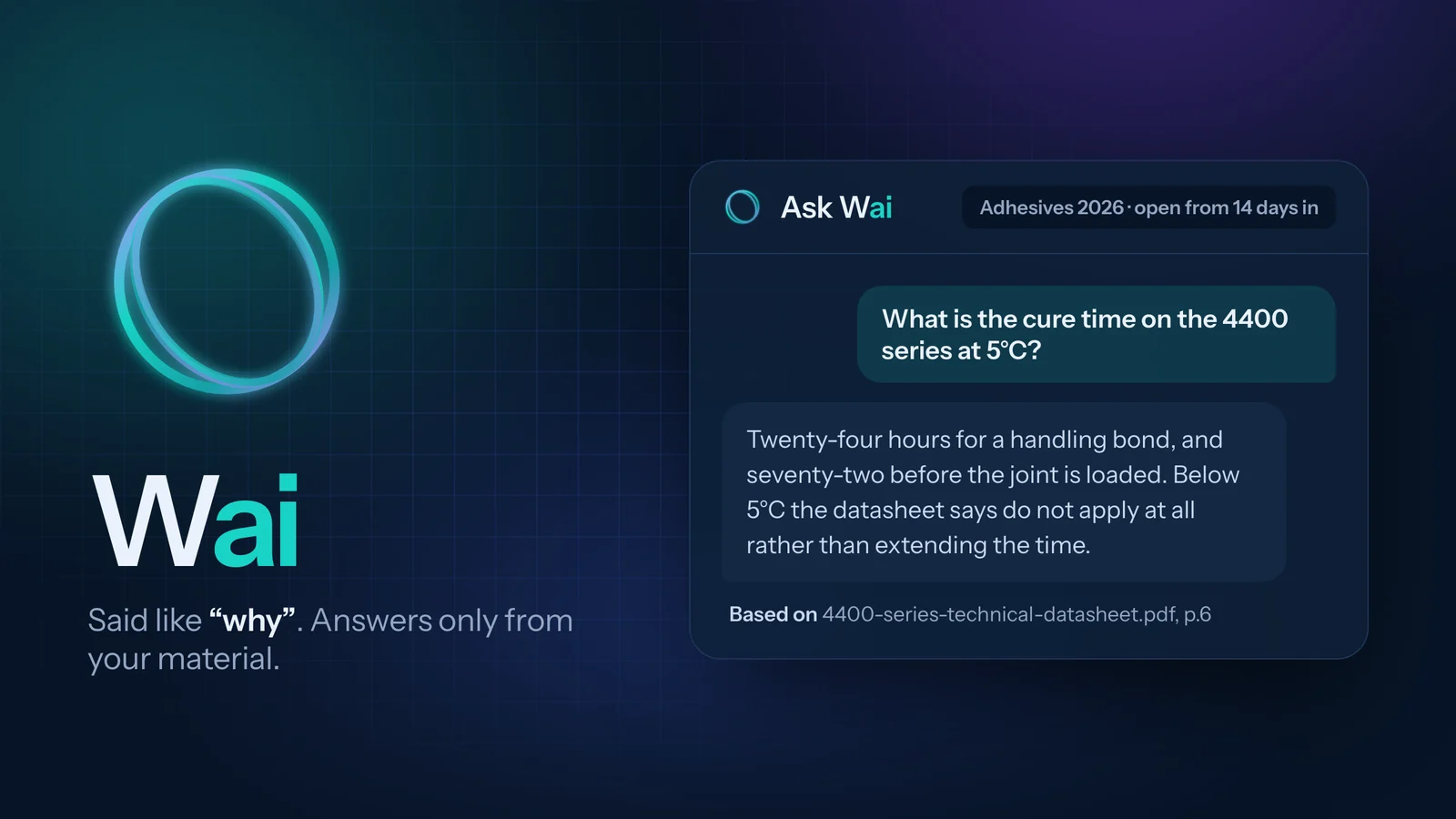
Introducing Wai, the AI That Refuses to Guess
Wai is the assistant built into Wranx. It reads every module you publish, every document you upload and every SCORM package in the archive, and it answers from those and nothing else. Each answer shows you where it came from. When Wai cannot find something, it says so instead of inventing it.

How should you award points for Certainty Based Marking?
We recently wrote an article for eLearning Industries that outlined three ways in which Certainty Based Marking (CBM) improves employee assessment. CBM expert Tony Gardner-Medwin from University College London responded to the article with an interesting and very valid comment, pointing out that the points scale shown in our article isn’t necessarily ideal for CBM to be effective. We agree with Tony, so we thought we’d pen a piece explaining how Wranx awards points for CBM!

Measure employee learning performance effectively with Wranx Analytics
Part of what can make Wranx so powerful for organisations are the learning principles on which it is based, like Spaced Repetition and Certainty Based Marking (CBM). To make the most of our – or any – platform, though, you need to understand the impact it is having and be able to measure employee learning, which is why we’ve rolled out our new, in-built analytics platform.
Digitising the NHS for the future, and the new Digital Academies
As the march towards digital transformation continues, the need to embrace and harness the power of technology could not be more evident. The NHS, ever moving and always under considerable pressure, presents huge demands of digitisation. Technology continually evolves to bring us new solutions, and with that comes a heightened need for skill enhancement. Training providers are already on board across the private sector, engaging with organisations in their need for new learning methods. It could be said that the public sector lags behind on this when, if anything, it should be at the forefront with the greatest need for the support technology can bring. A recent review within the NHS has highlighted a need for an increase in investment for training in technology, as well as the growing need for digitisation. A fund of £4.2 billion has been set aside for the project. For the service to maintain the highest standards in patient care, a new vision is necessary to future-proof the service. The review—carried out by Bob Wachter, a well-respected US clinician—has prompted Jeremy Hunt, the Health Secretary, to announce the introduction to the service of 12 digital academies. These 12 academies will be responsible for training 300
The need for digital skills in the boardroom
Here in the world of eLearning, we talk of the rise in the workforce of Millennials and how they react and interact with technology. We discuss the increasing demands of our new digital workforce for communication. With the workplace becoming our learning space, a digitally connected world of work is what we seek, what we’ve come to expect, and increasingly, what we need. Companies bring in eLearning providers, encouraging this digital workplace culture. We embrace it, and celebrate its many benefits. The Millennial workforce enjoys engaging and interacting in this way. They would. It is after all, their world. They are the digital natives. What about the boardroom? Can the same enthusiasm be expected from CEOs and other members of the management structure? Do they share our passion? Our experience? Do they even share our knowledge of the digital age? Or is it a world they fear, absolutely necessary but at the same time totally unfathomable? It may be time to reboot the boss. There is certainly a gap in digital skills at senior management level, and for a variety of reasons. The point about the Millennials isn’t a joke. Those who were born after the mid 80s are the
Tin Can API or SCORM : Which is best?
Organisations wishing to embrace eLearning face something of a dilemma when it comes to deciding between the two standards SCORM and Tin Can API. Some organisations already using SCORM to deliver courses may wonder if a move to Tin Can is worth the time and monetary investment. Weighing one against the other, however, may be a false comparison in many ways. The two are different beasts, and bring differing pros and cons to the eLearning table. Its all about strengths and weaknesses, and ultimately, it would also all depend on the type of courses organisations wish to deliver. It can seem like negotiating a minefield, but it doesn’t necessarily have to be that way. The first step here, is for businesses and organisations to understand exactly what they want for their staff, from any eLearning protocol. Once that becomes clear, then the decision should be fairly easy, but they are two individual journeys to a final destination, in effect. Two separate methods of realising similar results. In the world of eLearning, SCORM has been around for some time now, and while it still delivers results, its powers are limited. Tin Can API is the new kid on the block, the
Success for Wranx at Learning Technologies 2017!
We had a fantastic time last week at the Learning Technologies exhibition, which took place in London Olympia. The event is Europe’s leading showcase of organisational learning and the technology used to support learning at work. With more than 7,500 visitors each year, the exhibition really is the place to be if you are in the L&D sector! Our stand this year was a great success- it had three giant itabs and even a glowing brain!! People really loved the design and we definitely stood out! The stand was constantly busy with people looking to find out about Wranx and how we can help. Check out some of the feedback we had on the stand: “We haven’t seen anything like Wranx before” “We thought Wranx was another LMS but it’s not, it’s much more engaging” “Of all the exhibitors we feel Wranx is the most evolutionary” “So this is what bite-sizes learning should look like” The standard of customer engagement offered by the Wranx team is first class” All in all we had a great exhibition and are excited to continue the fantastic conversations we had over the two days! Didn’t make the event? One of our sales team would be happy to organise an online demo at
What colour is your personality? : Targeted training for The Palette Of Personalities
The training needs of organisations are many and various. With so many variables, the hunt is always on for a responsive, reactive method which enthuses and engages learners fully in the process. A method which makes the delivery of knowledge easier, faster, and more cost effective. A method of improving productivity which is inclusive, immersive and appeals to all demographics across the workforce. To that end, it is essential to understand the audience. Leaders may well know what they wish to teach, and when. However, in order to gain the fullest possible benefits from Learning and Development programmes, it is key to know who we’re trying to reach, and to recognise the differences in those people. We all live, learn, and work differently, and we all think differently. We have different demands from life, from our work and personal lives. Variables, again. Maybe the answer would be to look at some of those differences, and select a method of knowledge delivery which works for everyone. Or, at the very least, a method that can be easily adapted to work well for everyone. To begin that process, we need a way of understanding and mapping those differences in personality. How we
Themes in learning in 2016 – where we are and what’s around the corner
As we have completed another year of learning in the workplace, we are faced with an opportunity to look at developments, and to note several themes from 2016 which have led to much discussion amongst Learning and Development practitioners. In an ever changing world, and an increasingly fluid and dispersed workplace, it is wise to take notice of these developments in order to better understand modern learning techniques and trends. We need to know where learning will take us, what the future holds, and how businesses can benefit. Above all, one thing is certain. The expectations of business don’t change. In the corporate world where cost is king, and time is such a precious commodity, business leaders are looking to Learning and Development providers with a keen focus on ‘time to productivity’. They need and will expect more ‘bang to their buck’. Technology and new ways of thinking about learning provide us with fresh opportunity to meet these increasing demands. As always, the focus continues to be on how we learn, where we learn, and why. Its about how to engage, enthuse and encourage the learner. The future of learning lies at the place where human psychology and neuroscience meet the
Learning at the moment of need – the time is always now
So much to learn, so little time, and so many methods of learning. The formal. The informal. Learning in the here and now. The list goes on, and in the ever changing, fluid, developing world of work, there is ever more need for that learning to be accessed in an easier way. Now. Right now.
Reading about it is the easy part
See what daily retrieval practice looks like running on your own training content.