Knowledge becomes reflex.
Reading about an objection is not the same as handling one out loud. Voice Coach turns what a learner knows into what they can actually say — and because it runs on the same spaced-repetition model as their drills, it practises exactly what they keep getting wrong.
Your board has gone up twice this year. Give me one reason I should not switch to the cheaper spec.
Fair question. Can I ask what you are comparing on — board price, or installed cost per square metre?
Board price. That is what my estimator looks at.
Understood. On board price we are dearer. On installed cost we come out about nine per cent lower, because of the waste rate and the fix time. Would it help if I showed you that side by side?
Go on then. But make it quick.
Martin Shaw · 2m 41s
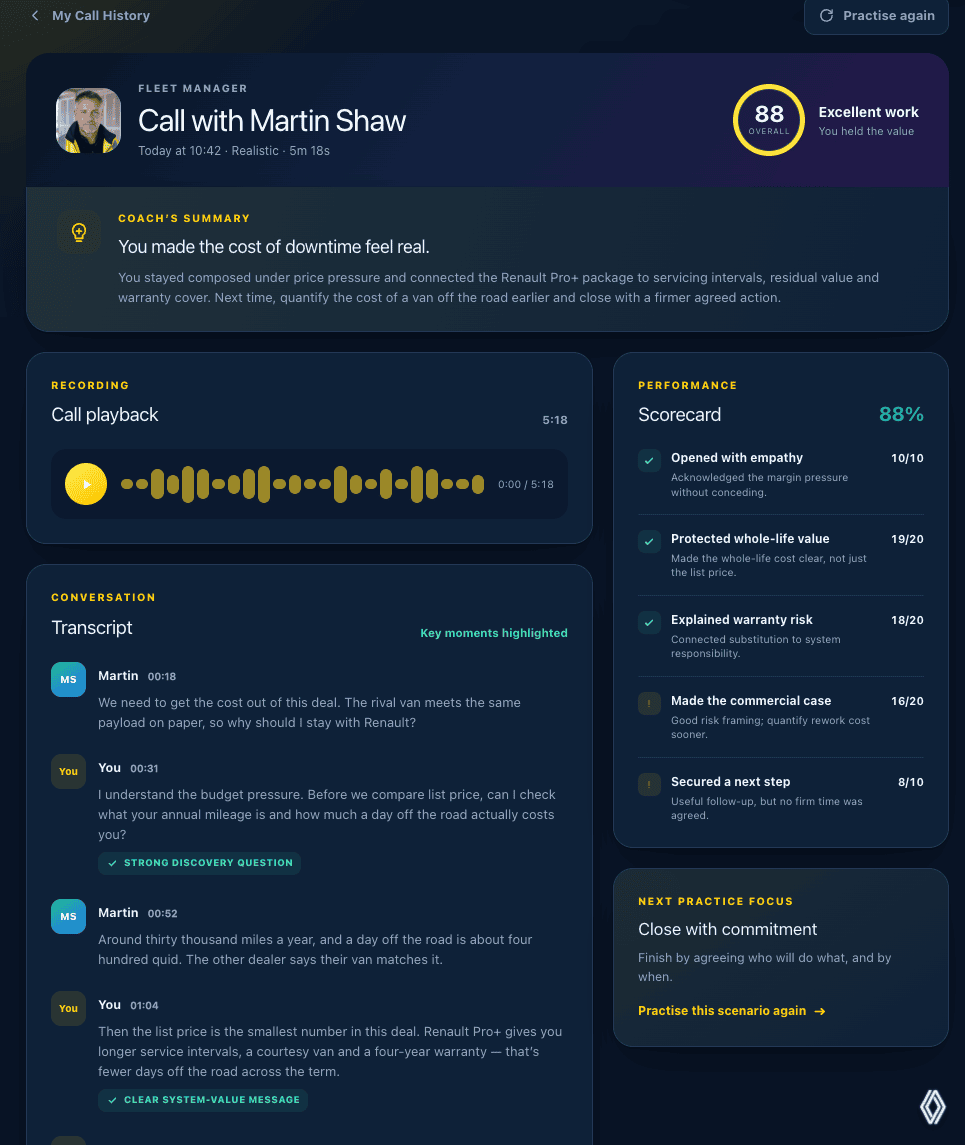
At 02:18 you asked for the meeting before naming a next step. Martin agreed to look, but you never booked the follow-up.
Three closing drills, plus one repeat call with Martin in four days — spaced, not crammed.
Your team can pass the module and still freeze on the call
Every L&D team knows the gap. Completion is at 96%, the quiz scores look excellent, and then you listen to a recording.
Roleplay does not scale
Practice means booking a manager, a room and an hour. It happens twice a year, for the people who need it least.
Feedback is inconsistent
Two managers score the same call differently. Neither writes it down. Nothing compounds.
Nobody practises the hard one
Volunteers rehearse the objection they are already good at. The one that loses deals never comes up.
Four steps, about three minutes
Voice Coach sits inside the daily habit rather than beside it. A learner finishes their drills and the call is already queued.
-
01
We pick the call
Not at random. The persona and objection are chosen from the concepts this learner is weakest on, straight out of their mastery record.
-
02
They talk
A real conversation with an AI customer that interrupts, pushes back and changes its mind. No script to read from.
-
03
We score what they said
Five named skills, graded turn by turn on reasoning rather than keywords, with the exact moment that cost them points.
-
04
It feeds the ladder
A strong call is evidence of Apply on those concepts. A weak one queues targeted drills and books the repeat call.
Any conversation that has to go right first time
Objection handling is where roleplay usually starts. It is not where it stops. The same call works anywhere the exact words matter and there is no second attempt.
The price you have to justify
The customer who wants to know why one jacket costs three times the other, on a Saturday, with a queue behind them.
The complaint at 11pm
The upgrade that is not available, the allergy question, the guest who has already had a bad night. Handled out loud before the front desk meets it.
The sceptical clinician
Seven minutes, one objection and no second appointment. Rehearsed and scored so the first time is not in the clinic.
The question on the forecourt
Range anxiety, the finance comparison, the rival model somebody read about last night, answered before a customer asks it.
The intervention nobody volunteers for
Responsible-gambling conversations and the complaint that follows. The hardest thing to practise, and the one most worth practising.
The conversation with your own team
Feedback that lands, an underperformance discussion, the return-to-work meeting. The person on the other end is not always a customer.
Voice Coach is multilingual. The call, the scorecard and the feedback all happen in the language your people actually work in.
Practise against the customer you dread
Persona sets are built from your own industry, your own objections, your own product names. Each one has a mood, a difficulty and a habit of not making it easy.

Martin Shaw
“Your board has gone up twice this year. Give me one reason I should not switch to the cheaper spec.”

Claire Bennett
“I need the fire and acoustic test data before I will specify it. Do you have the certificate to hand?”

Graham Foster
“I have shelf space for one of these. Why yours, and can you actually keep it in stock?”

Daniel Hughes
“I am three weeks behind. Tell me how this does not add a single day to my programme.”

Rebecca Taylor
“It is dearer up front. Talk to me about what it costs me over thirty years, not this quarter.”

Oliver Grant
“Your rate sits above my cost plan. Where is the saving elsewhere that justifies it?”
Practise on a phone, not in front of a camera
You can buy roleplay with a talking avatar on screen, and we decided not to build it. The conversations these teams need to rehearse happen down a phone, across a counter or beside a bay — the picture was never part of them. A camera adds a quiet room to book, a render to wait for and a self-consciousness that has nothing to do with the skill, and it gives the scorecard nothing it can read. Voice runs on the handset already in somebody’s pocket, in the three minutes between customers. That is where practice has to fit if it is going to happen at all.
Graded on what they said, not whether they turned up
Five named skills, scored turn by turn. The scorecard names the moment it slipped, which is the part a completion percentage can never give you.
Discovery
Did they ask before they pitched? Voice Coach counts genuine questions, not rhetorical ones.
Objection handling
Whether the objection was answered or deflected, and whether the answer was actually true.
Value framing
Reframing unit price as cost per store per year is a skill. It is also gradeable.
Active listening
Did they use what the customer just told them, or carry on down their own track?
Closing
A next step, named and agreed. The rung most people drop, most often.
These five are the default set, not a fixed one. The skills a call is graded on are defined per programme — a return-to-work meeting is not scored on value framing, and a responsible-gambling intervention is not scored on closing.
Readiness you can see before the quarter starts
Not who completed the training. Who can actually hold the conversation, on which objection, and who needs another pass this week.
Team readiness by skill
See at a glance that closing is the weak rung across the whole team, not a personal failing of one rep.
Ramp-time trend
Track how long a new starter takes to reach Apply on the core objections, cohort by cohort.
Who needs which drill
Every low-scoring call queues its own follow-up automatically. Nobody has to build a remediation plan by hand.
Recordings and transcripts
Every call is transcribed and kept, so coaching conversations start from evidence.
It is practice, not surveillance
Voice Coach runs when a learner chooses to start a call. Practice calls are visible to the learner and their manager, they are never scored against live customer conversations, and a bad call costs nothing — mastery in Wranx only ever rises through demonstrated understanding, and fades with time. There is no negative marking anywhere in the model.
And when they need the answer rather than the practice
Wai is the other half of the AI in Wranx: an assistant that answers from your own modules, documents and SCORM archive, cited, and only where your scopes allow. It runs against the same record of what each learner knows that Voice Coach does — so what somebody keeps having to look up is what turns up next in their practice.
Explore WaiHear it before you buy it
Request a demo and we’ll build a persona from your own objections, then let you take the call yourself.