Ask it anything. It answers from your material.
Wai is the assistant built into Wranx. It has read every module you have published, every document you upload and every SCORM package in the archive — and it answers from those and nothing else. What it may see is yours to decide, down to the individual release.
Ask Wai
Wranx help · always availableWhy am I being asked something I already got right?
Because getting it right once is not the same as knowing it. Wranx brings a question back as it is about to fade, and the gap widens each time you answer it confidently — so a concept you are solid on returns rarely, and one you are shaky on returns tomorrow.
Based on How the daily drill decides what to ask
Ask Wai
Adhesives 2026 · open from 14 days inWhat is the cure time on the 4400 series at 5°C?
Twenty-four hours for a handling bond, and seventy-two before the joint is loaded. Below 5°C the datasheet says do not apply at all rather than extending the time.
Based on 4400-series-technical-datasheet.pdf, p.6
Ask Wai
Site induction 2019 · always availableWhat does the induction say about working near an open edge?
Edge protection first, harness second, and never the harness on its own. The induction is explicit that a harness is what catches you when the barrier has already failed — it is not a substitute for the barrier.
Based on Site Induction 2019 (SCORM) — Module 3, “Working at height”
Wai — said like “why”. A wai (Thai: ไหว้) is a greeting: palms together, a small bow. It is hello, thank you and a mark of respect in one gesture — and it happens to sound like the question your people are really asking.
The answer was always there. Nobody could find it.
Every organisation we work with is sitting on more training material than any one person can hold, and almost none of it is reachable at the moment somebody actually needs it.
The search box does not work
The answer is in a PDF, a slide deck and a course somebody exported in 2019. None of it is searchable, and the one person who knows where it lives is on annual leave.
So they ask whoever is nearest
The answer arrives at whatever accuracy that colleague happens to have. It is never written down, never checked, and it spreads.
Or they take a guess
On a shop floor, a rig or a ward, the cost of a confident guess is not a lower quiz score at the end of the month.
It has already read everything you own
Wai indexes four things and answers from those only. There is no general knowledge behind it and no browsing the internet — if the answer is not in your material or in our help, Wai says so.
Your Wranx modules
Every published module, question and explanation in your own account — the content your team already learns from, now answerable in a sentence rather than findable in a menu.
The documents you upload
PDFs, Word files and slide decks: spec sheets, policies, playbooks, the safety notice that came round in March. Scanned pages too — an image-only PDF is read with OCR rather than quietly skipped.
The SCORM archive
Packages exported from Storyline, Captivate or an LMS you left years ago. Wai unzips them, reads the manifest and indexes the text inside, without anybody rebuilding a thing.
Wranx’s own help
How the drill decides what to ask, why a question came back, what the streak counts. The support questions your L&D team currently answers one at a time.
Answers, plans and quizzes on one canvas
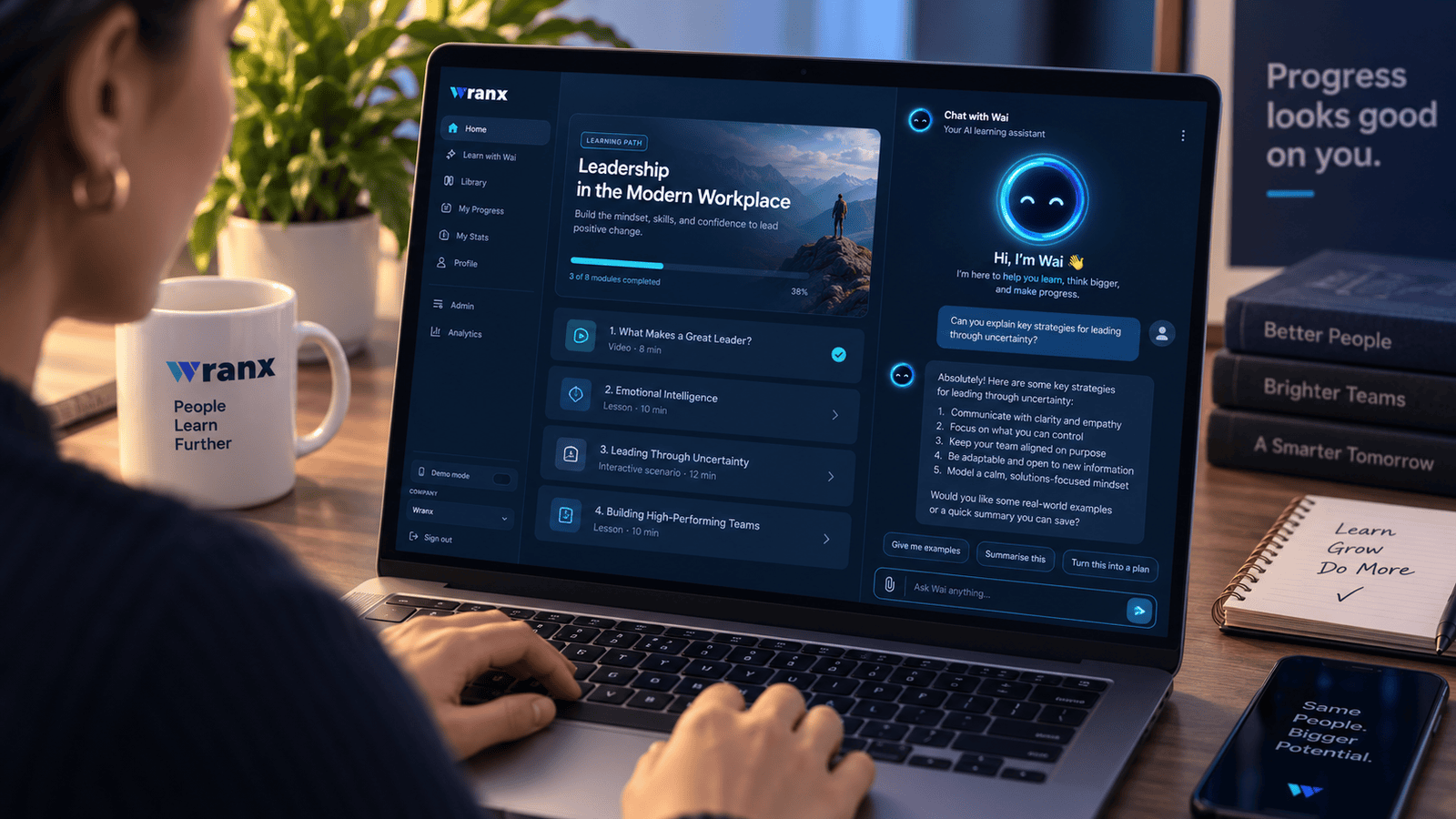
Wai runs on a split canvas alongside the learner’s plan. Answers carry the source they came from, and a quiz drops into the conversation on whichever concept the learner keeps missing.
It only knows what you let it know
Two independent locks. Neither one depends on the other holding.
A module is a bank of questions with their answers. Index one carelessly and a learner can ask Wai for the answer to the question they are about to be drilled on — replacing retrieval practice with lookup, inside the product whose entire claim is that retrieval practice works.
So exposure is something an author switches on deliberately, per release. Material is indexed either way; what a scope controls is whether Wai may ever answer from it.
When Wai may answer from a release
Set per release, by whoever publishes it.
- Never
- Wai never answers from this material. Where every release starts.
- Once they have been tested
- Opens the moment that learner has actually been asked the question. Looking something up straight after being tested is consolidation, not avoidance — and it is the strongest signal there is that the concept needs another pass.
- A number of days in
- Counted from the day that learner started, not from a date in your calendar — so somebody joining in June gets the same run-up as somebody who joined in March.
- From a fixed date
- The same day for everybody. For a launch, a regulation change, a product going live.
- Always
- For reference material with nothing to give away.
Your content never leaves your account
Each customer’s material is a separate corpus with its own boundary. There is no query path that can return another organisation’s content, and the test that proves it is one that blocks a release when it fails.
Scoped to the learner, not just the org
A learner reaches only what their own enrolment has opened. Two people at the same company can ask Wai the same question and correctly get different answers.
A decision you can change on Tuesday
A date that passes opens the material that night. Nothing has to be re-uploaded, re-indexed or re-published for a scope change to take effect.
The archive nobody can search, searchable
Most organisations have years of SCORM in a folder somewhere — courses that cost real money, that nobody can look inside, and that no one is ever going to rebuild. Wai reads them.
-
01
Opens the package
Unzips it and walks the manifest — SCORM 1.2 and 2004 alike — so it follows the course’s own structure rather than guessing at a pile of files.
-
02
Reads the pages
Pulls the text out of the HTML the course was built from, in the order a learner would have met it.
-
03
Reads the pictures
Text baked into a screenshot or a diagram is recovered with OCR. It is the part of an old course most likely to hold the thing somebody needs.
-
04
Listens to the narration
Where a module’s substance is in the voiceover, that can be transcribed and indexed too. It carries a real cost, so it is a switch you turn on rather than a default.
It tells you what it could not read
Old packages are messy, and some of them hold content no extractor can reach. Every package reports what indexed and what did not, per asset — so you know where the gaps are instead of discovering one the day a learner asks about it.
This is reading, not playing
Wai indexes your SCORM so it can be asked about. It does not turn Wranx into a SCORM player, and we would rather say so here than let you find out after signing.
What they look up becomes what they get drilled on
A knowledge base is performance support — the cognitive opposite of retrieval practice, and on its own it is a commodity. What is not a commodity is what happens next.
-
01
It notices
Every question is logged against the concept behind it rather than the words it was asked in, so “fire rating” and “how long does it hold” count as the same gap.
-
02
It spots the pattern
Five look-ups on one concept in a month is not curiosity. It is somebody doing their job around a hole in what they know.
-
03
It offers
“You have looked this up five times — shall we bank it?” Asked in Wai, in their own words, and never as a telling-off.
-
04
It schedules
Accept, and the concept joins the spacing engine like any other, returning as it is about to fade. Decline, and nothing happens at all.
Asking is never held against anybody
Nothing a learner asks Wai can lower their mastery, flag them to a manager or appear in a report as a weakness. The loop only ever adds practice. A question asked is the most honest signal we get about what somebody needs, and the fastest way to stop getting it is to make it cost something.
Your assistant, your name, your character
Wai is what we call it. Your learners never have to — and they never have to meet our face either.
One shipped design, three brands. Recolouring is free because the artwork is drawn in your tokens — but it is the floor, not the ceiling: a character built for you is a different design altogether.
It takes your name
Call it Ada, call it Ollie, call it the Help Desk. Every sentence the assistant appears in is written around the name rather than having it bolted on, so a rename reads properly in all of them.
Or a character drawn for you
Pick from the designs Wai ships with, or have one made: your own mascot, an existing character your people already know, something built from scratch to belong in your world. It arrives as artwork, not a photograph pasted into a circle, so it holds up at every size and moves the way the others do.
It takes your palette
The shipped designs are drawn from your brand’s own colour tokens rather than shipped as images, so they recolour themselves — correctly, in light and dark — the moment your palette is set. There is no asset to commission and nothing to re-export.
It takes your tone
The greeting a learner meets is yours to write. So is what the assistant calls itself when it cannot answer, which is the line that decides whether people come back to it.
It would rather tell you it does not know
When Wai cannot find an answer in your material, it says so and points at whoever can actually help. That is not a limitation we are apologising for — an assistant that invents a fire rating, a dosage or a returns window is worse than no assistant at all. Every answer it does give carries the source it came from, so nobody has to take it on trust.
“I can’t find that in your training materials. I only answer from what your organisation has given me, so I’d rather say I don’t know than guess. Whoever arranged your training will be able to help.”
Point it at your own material
Request a demo and we’ll index a document of yours before the call, then let you sit and ask it anything.