Microlearning only works
if they open the app.
Short content is easy. Getting someone to come back tomorrow, and the day after, for months — that is the part everything else depends on.
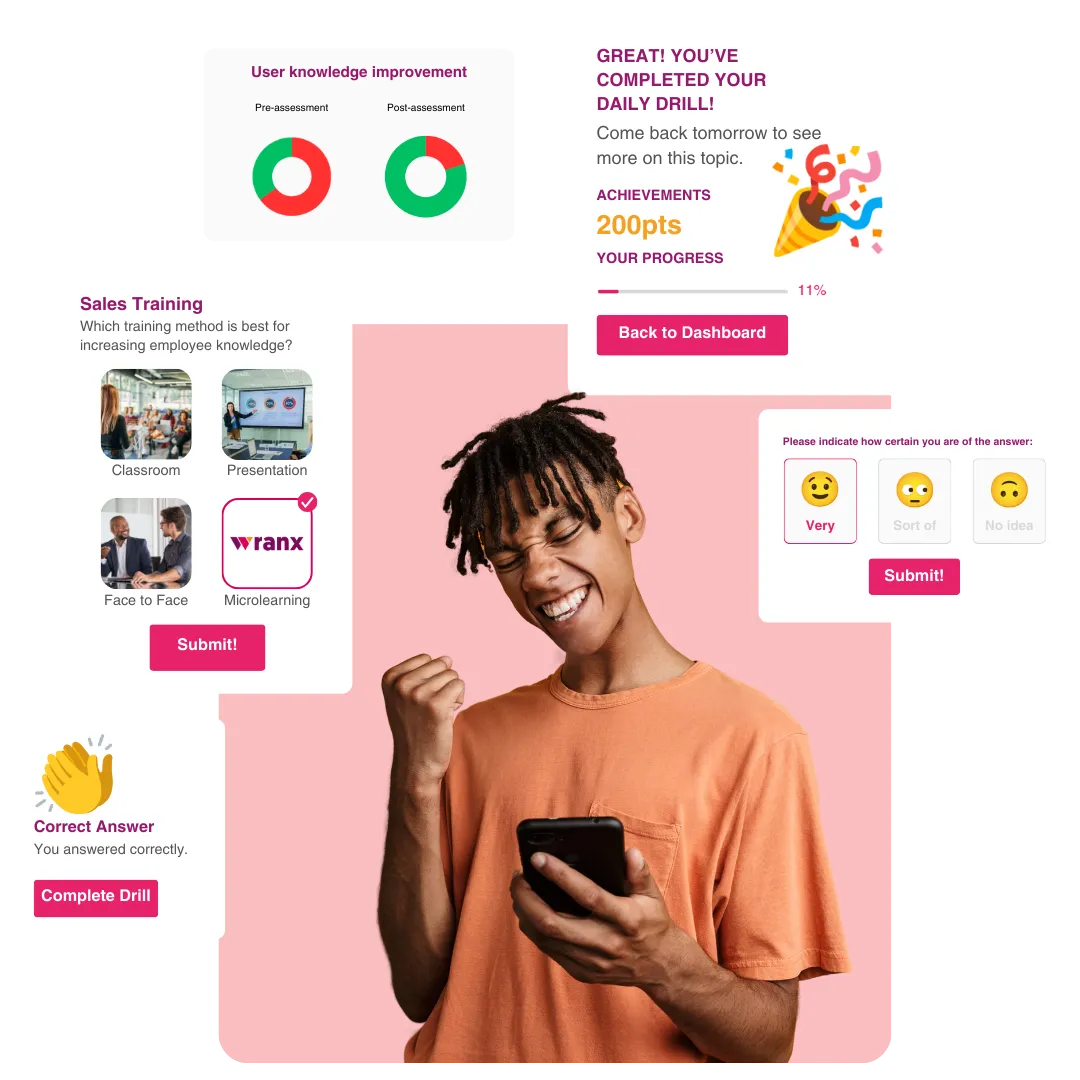
Short enough to become a habit
Two to three minutes is not a marketing figure, it is the constraint every other decision defends. It is short enough to happen before a shift, during a quiet spell or in a car park, which is what makes daily use realistic.
The North Face EMEA saw staff logins rise 274% and training hours logged rise 483% on that format — not because people were told to, but because it asks for so little.
Framed as your world, not our platform
White-label usually means a colour picker and a logo upload. We rebuild the metaphor: a racecourse for a car maker, an ascent for an outdoor brand, a shop floor for a retailer — and rename every concept inside it.
Learners never meet a piece of platform vocabulary. They see a progression that already means something to them, in the language their team already uses.
Competition, carefully
Streaks, standings and trophies work, and they can also do damage in the wrong setting. Each brand chooses how visible any of it is: private, within a team, or across the whole company.
Private is the default rather than an afterthought — and when standings are on, the ranking is by concepts secured rather than points collected, so the board rewards knowing things.
Why teams keep opening it
Engagement is not a feature you add at the end. It is what the format is designed around.
Quick and engaging
Two to three minutes a day, on a phone, in a gap that already exists. Nobody is taken off the floor to learn.
Long-term retention
Spaced repetition brings each concept back as it is about to fade, so knowledge is still there months later rather than days.
Confidence, measured
Certainty-based marking separates someone who knows it from someone who guessed right — the difference that matters on the job.
Competitive elements
Streaks, progress and standings keep people coming back, and can be switched off entirely where a league table would do harm.
Any device, any time
Runs on whatever people already carry, around shifts and time zones, with progress synced across all of it.
Proof, not completions
Reporting on what each person actually knows, concept by concept, rather than who clicked through the module.
Works on whatever people already carry
iOS, Android and the web, with progress synced across all of them, plus delivery through Slack and Microsoft Teams for teams that already live there.
Wranx success stories
See how managers, like you, are using Wranx to make training land.
With traditional e-learning you can get saturated with information and knowledge – and that becomes useless. Wranx does the complete opposite and allows learners to digest information easily and at their own pace.
This platform has had a direct impact on our customers, as a higher level of training has ensured they have an enjoyable experience in store. The uplift in sales is clear, as customers said they were influenced by our store colleague’s advanced product knowledge!
I have heard nothing but positive feedback from our employees about using Wranx. It’s a much more doable format for them and almost makes a game out of learning. It’s more bite-sized and doable on a repeat basis.
The North Face EMEA
How The North Face EMEA Boosted Training Engagement by 274%
L’Oréal Matrix
How L’Oréal Matrix Improved Product Knowledge Across Remote Teams
IGT
How IGT Eliminated Misinformation With Microlearning-Driven Compliance
More in Platform
The same engine, pointed at a different problem.
See the app your teams would actually use
Tell us what your people do all day and we’ll show you the world we’d build for them.