Train smarter,
not harder.
A fixed course order assumes everyone forgets the same things at the same rate. They do not — so the schedule should belong to the learner, not the curriculum.
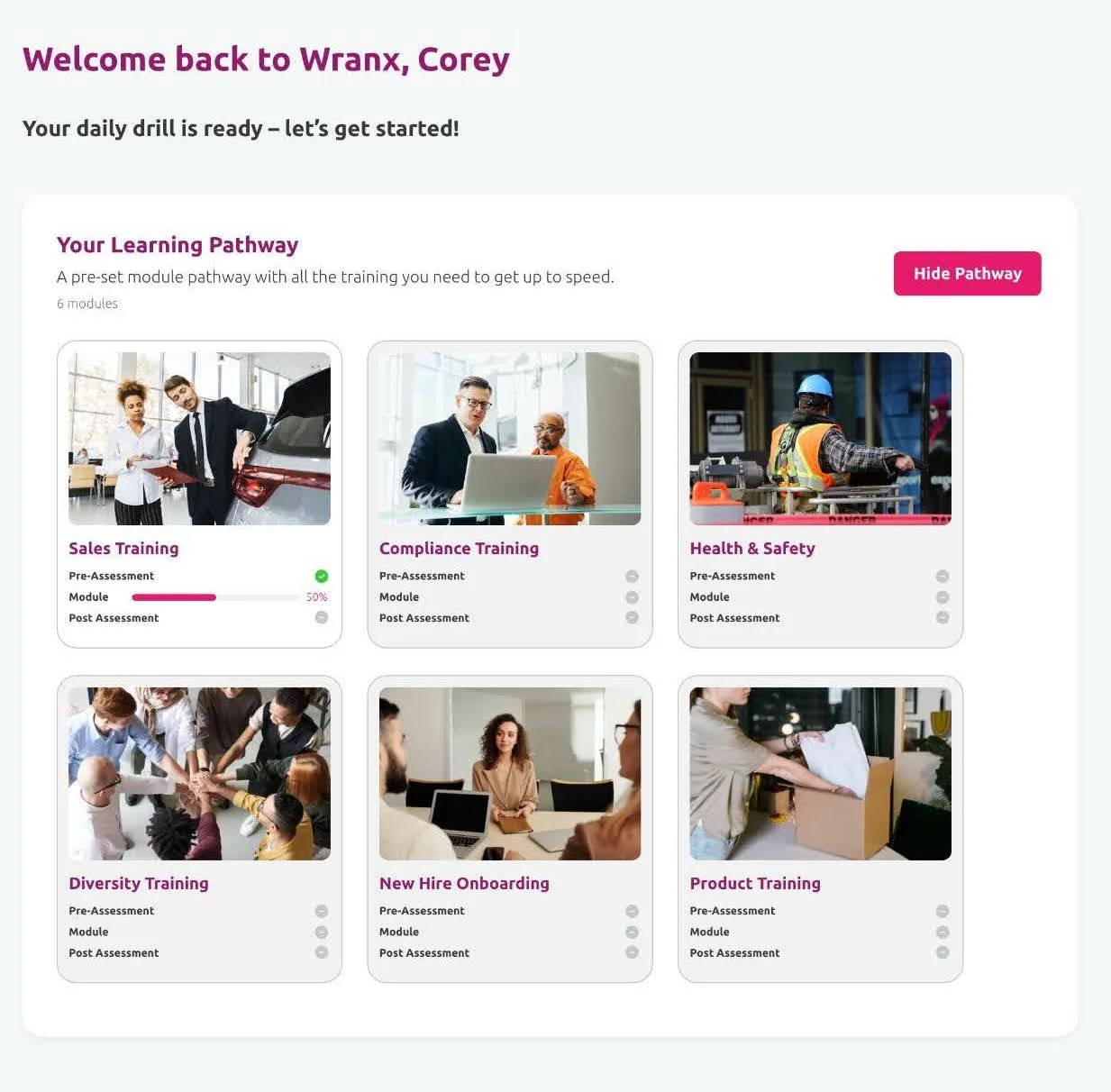
One pathway per person, not per course
Two people on the same programme rarely need the same thing next. One has product knowledge secure and is shaky on policy; the other is the reverse. A fixed sequence serves neither of them well and wastes the time of both.
Wranx schedules every individual concept for every individual learner. What comes next is decided by what that person has actually demonstrated, so nobody is drilled on something they already know or moved past something they do not.
Progression that means something
A pathway is a climb through named stages rather than a progress bar. Learners can see what they have secured, what is next and what it unlocks — framed in your organisation’s own language rather than platform vocabulary.
Mastery only ever rises through demonstrated understanding, and fades through time. Nothing is scored negatively, so the ladder measures knowledge rather than punishing a bad day.
Role by role, without building it twice
Different roles need different pathways, and most of the underlying content is shared. Assign the concepts a role actually needs and the scheduling takes care of the rest, rather than maintaining a separate course per job title.
When someone changes role, their existing mastery comes with them. They pick up the new material and keep what they had already proved.
Why run pathways on Wranx
Personalisation here means the schedule genuinely differs per learner, not that the course greets them by name.
Quick and engaging
Two to three minutes a day, on a phone, in a gap that already exists. Nobody is taken off the floor to learn.
Long-term retention
Spaced repetition brings each concept back as it is about to fade, so knowledge is still there months later rather than days.
Confidence, measured
Certainty-based marking separates someone who knows it from someone who guessed right — the difference that matters on the job.
Competitive elements
Streaks, progress and standings keep people coming back, and can be switched off entirely where a league table would do harm.
Any device, any time
Runs on whatever people already carry, around shifts and time zones, with progress synced across all of it.
Proof, not completions
Reporting on what each person actually knows, concept by concept, rather than who clicked through the module.
Built on the mastery ladder
Every pathway runs through the same three rungs: recall it, explain it in your own words, apply it to a situation nobody drilled you on. The third is the one that shows up in your numbers.
Wranx success stories
See how managers, like you, are using Wranx to make training land.
With traditional e-learning you can get saturated with information and knowledge – and that becomes useless. Wranx does the complete opposite and allows learners to digest information easily and at their own pace.
This platform has had a direct impact on our customers, as a higher level of training has ensured they have an enjoyable experience in store. The uplift in sales is clear, as customers said they were influenced by our store colleague’s advanced product knowledge!
I have heard nothing but positive feedback from our employees about using Wranx. It’s a much more doable format for them and almost makes a game out of learning. It’s more bite-sized and doable on a repeat basis.
Vertex
How Vertex Cut Training Time by 87% and Increased Knowledge Retention by 60%
PSA Peugeot Citroën
How PSA Peugeot Citroën Cut Training Costs by £2.5M and Boosted Knowledge by 91%
More in By capability
The same engine, pointed at a different problem.
Give every learner their own route
Tell us the roles you train and we’ll show you the pathways we’d build for each.