The Policy Changed on Monday. Your Training Didn't.

The pricing changed on Monday. Somebody rewrote the returns policy on Tuesday, the regulator moved a threshold on Wednesday, and a supplier discontinued the line your best seller is built around on Thursday.
By Friday all of that exists as documents. Circulated, acknowledged, filed. And the knowledge in your team's heads is still the knowledge they had a week ago, because a document being sent to somebody has never once been the same event as somebody knowing it.
Everyone in L&D knows what closes that gap. Short questions, spaced out, repeated until the thing holds. What nobody has is the week it takes to sit down and write two hundred of them.
So the training arrives next quarter, and by then something else has changed.
The document is not the training
It is worth being blunt about the step everybody skips, because it is the expensive one.
A policy PDF is a reference object. It is written to be complete and correct, which is exactly what you want when somebody is looking something up and exactly the wrong shape for building memory. Nobody retains twelve pages by reading them. They retain them by being asked, on a Tuesday, whether a sale item bought eleven months ago is covered, and having to answer before they see the answer.
Turning the first thing into the second is real work. Somebody has to decide which of the twelve pages actually contains a decision anybody will ever make, split that into concepts small enough to be asked about one at a time, and then write questions that a person could get wrong for the right reasons. Do it properly for one policy and you have lost a couple of days. Do it for a product catalogue and you have lost a month you were never given.
That work is the entire reason the lag exists. Not the platform, not the learners, not the appetite. Just the fact that somebody has to write the questions.
Three ways to get from a document to a drill
Wranx gives you three, and they are not ranked. They suit different weeks.
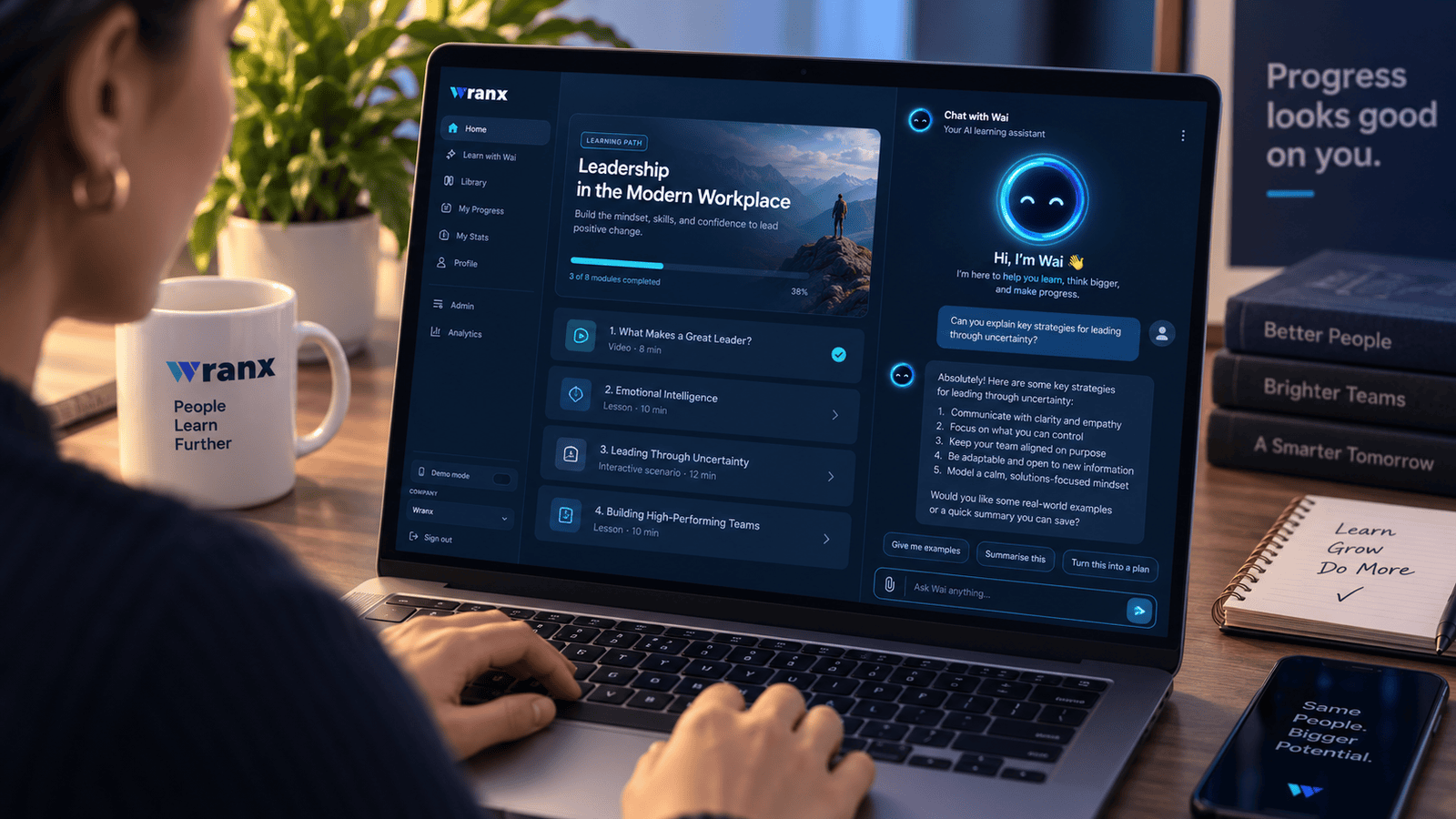
Upload it and let the AI draft it. You give it the policy, the spec sheet, the deck, the update the regulator published this morning. It comes back with question based training built around the concepts in that material, spaced and scheduled the way the evidence says it should be. This is the one that turns a month into an afternoon, and it is the one most teams reach for when something has just changed and the answer needs to be in people's heads this week rather than in Q1.
Write it yourself. Some material genuinely needs the person who knows it. Compliance wording where a shade of meaning matters, internal terminology that has to be exactly your terminology, the four questions on a process that only three people in the building understand. The authoring tools are there for the same reason a good kitchen has knives as well as a food processor.
Hand it to us. Our content team will build it with you, which is usually the right call for a company wide launch, or when a programme has to be right first time and there is no capacity in the building to make it so.
Most customers use all three, and the mix moves around. The point is not that one of them is best. It is that "we didn't have time to write the questions" stops being a reason the training did not happen.
A question is only worth what it can prove
Here is where generated content usually goes wrong, and it is worth understanding before you judge any tool that offers it, ours included.
Ask a model for questions about a document and you will get multiple choice. Hundreds of them, quickly, all perfectly serviceable and all testing the same thing: whether somebody can recognise the right answer when it is sitting on the screen next to three wrong ones.
We have written at length about why that is not the same as knowing something. The mastery ladder tracks every concept up three rungs, and the rung a question can earn is decided by the question's own shape. A closed question can move a concept to Recall and no further. Not at fifty questions, not at five hundred. If somebody has to be able to say why, a question that offers them the words cannot show that they could have found them.
Which means a generator that only writes multiple choice quietly caps your entire programme at the bottom rung, and does it while producing a very impressive number of questions.
So generation in Wranx writes to the rung the module is aiming at. Closed formats for the facts that simply have to be there, in the mixed variations the drill schedule needs so that a concept comes back as a fresh question rather than the same one again. Open questions where a learner has to put the reasoning in their own words. Scenarios, for the concepts where the real test is a situation nobody drilled them on, feeding the same material into live roleplay where the customer pushes back.
The honest version of this is that a generated question is a draft. It comes from your document, it can be read against the clause it came from, and it is meant to be edited by somebody who knows the subject before it goes anywhere near a learner. That review takes an afternoon. Writing the two hundred from nothing takes the month you did not have.
Not everything should become a drill
There is a failure mode on the other side of this, and it is the one we see most often in platforms that have just discovered they can generate content.
Everything becomes questions. The datasheet becomes questions. The forty page supplier manual becomes questions. The SCORM course from three vendors ago becomes questions, and now your people have a daily drill on a torque figure they will look up every single time because looking it up is the correct professional behaviour.
Most of your material is reference, not curriculum. It should be answerable, not memorised. That material belongs in Wai, which reads it, answers from it and shows the page it came from, without anybody being drilled on a number they were always going to check.
The test we use is simple enough to apply in a meeting. If somebody has to know it in the moment, with a customer in front of them and no phone in their hand, it is a drill. If they will always have thirty seconds and a screen, it is reference. Getting that split right is the difference between a programme people take seriously and a programme they learn to click through.
What that buys you
The change is not that content gets made faster, although it does.
The change is that training stops being a thing that happens to a plan and starts being a thing that happens to an event. The price list moves and the questions about the new price list are in the drill schedule before the week is out. A regulator publishes on a Wednesday and the people who need it are being asked about it on Thursday, in two minutes, on a phone, in a car park.
Nobody has to choose which of this quarter's four changes is the one worth building a programme for. That choice was never a training decision anyway. It was a capacity decision wearing a training decision's clothes.
See it against your own material
Send us the most inconvenient document you own. The policy nobody has updated the training for, the spec sheet with the fifteen variants, the induction deck that is three products out of date.
Book a demo and we will build the concepts from it before the call, then go through what came back with you, including the questions you would throw out. That conversation tends to be more useful than the ones where everything works.
Or read the longer version first: the three ways to create content, and how the drills and scheduling work once the content exists.