Employee Training
8 articles on Employee Training.

The Policy Changed on Monday. Your Training Didn't.
Every organisation has the same lag. The document is written on Monday and the people who need it know it some time next quarter, because somebody has to turn twelve pages into questions and nobody has the week. Here is how Wranx closes that gap, and why the questions it writes have to be more than multiple choice to be worth anything.
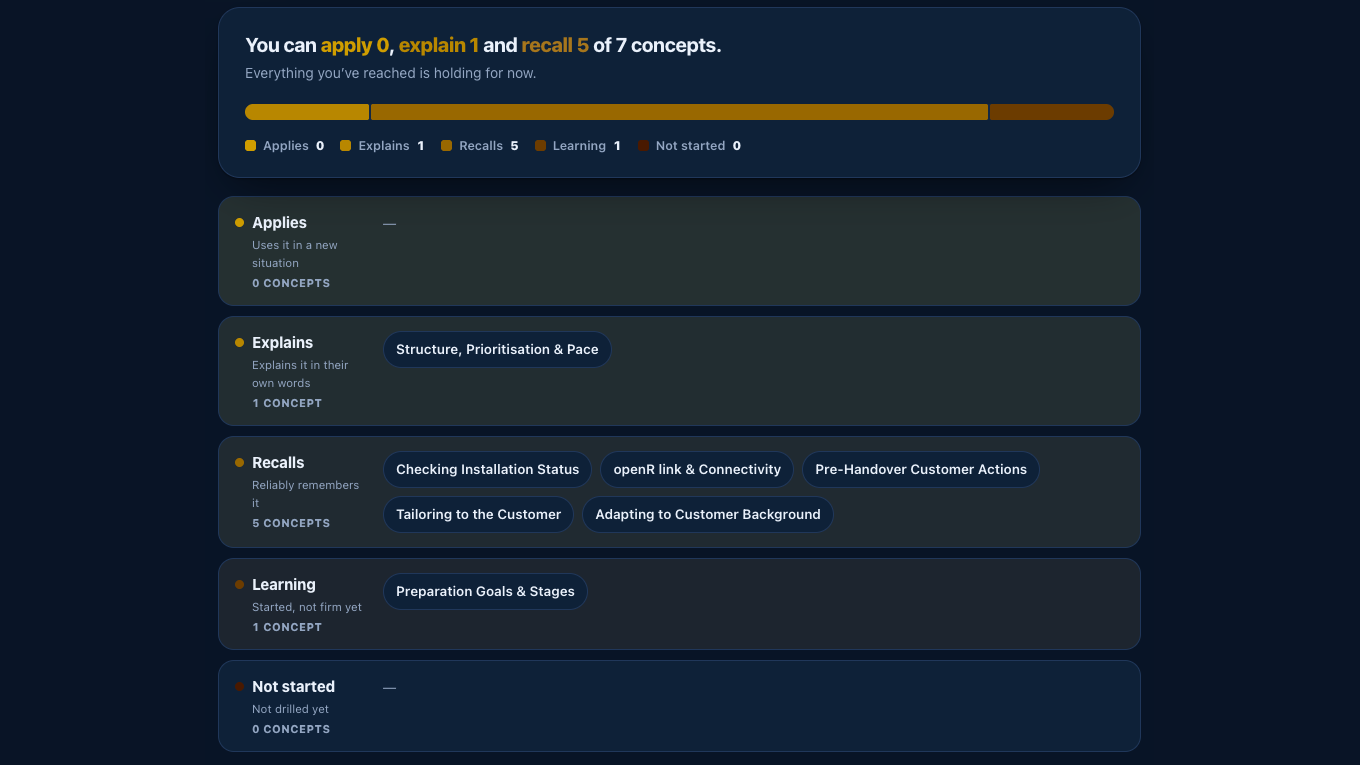
The Wranx Mastery Ladder: Three Rungs, Not One Pass Mark
Most platforms measure whether someone can pick the right answer and call that knowing it. Wranx tracks every concept up three rungs instead: whether a learner can recall it, explain it in their own words, and apply it to a situation nobody drilled them on. Here is how each rung is earned, and why only the third one belongs in a readiness figure.

Human Touch vs AI in Employee Training
In the realm of employee training, there’s an ongoing debate: should we rely on human touch or embrace the advancements of AI? Both sides have valid points, and the key lies in finding the ideal harmony between the two approaches. Understanding Human Touch in Training Human touch in training embodies the personal interaction and empathy

Employee Training and Development: Enhancing Workforce Performance
Employee training and development encompass a range of activities aimed at enhancing the knowledge, skills, and abilities of employees within an organization. It involves systematic efforts to improve individual and organizational performance through learning initiatives. Investing in employee training and development is imperative for organizations striving to stay competitive and adapt to evolving market demands.

Top 10 Staff Training Techniques for L&D Leaders in 2024
Learning and development (L&D) remain critical components of business success, and its leaders are continually seeking innovative ways to train and upskill their teams. In today’s fast-paced, ever-changing work environment, the delivery and design of training programs have become more important than ever. As an L&D leader, staying updated on the latest techniques and employee

Mastering Employee Training Assessments: 10 Steps for Success
In the realm of Learning and Development (L&D), nailing employee training assessments is crucial for success. It’s not just about measuring training program effectiveness or knowledge retention. It’s a deeper endeavor that aligns personal growth with organizational goals, ensuring a win-win investment and outcome relationship. As a leader in L&D, crafting these assessments is a big responsibility, and there’s no room for error. That said, let me share a 10-step plan that I truly believe can take your assessments from functional tools to game-changers for success. Step 1: Set Clear, Measurable Goals Training without clear objectives is like sailing without a compass. Starting with well-defined goals not only sets the direction but also helps you measure the outcome effectively. When these goals are specific, measurable, achievable, relevant, and time-bound (SMART), you can directly link training to business outcomes – the holy grail of L&D. Step 2: Understand Your Audience When it comes to assessment, it’s crucial to tailor it to cater to the diverse range of learners. Understanding their roles, experiences, and learning needs is key. We should create assessments that aren’t just evaluative, but also educational, putting ourselves in the employees’ shoes. Step 3: Employ a Variety of Assessment

Solving the Global Skills Shortage with Effective Internal Training
In a world marked by rapid technological advancements and evolving industries, the global skills shortage has emerged as a pressing concern. This article delves into strategies for Addressing the Global Kills Shortage with Effective Internal Training, offering actionable insights and expert perspectives to bridge the gap and foster professional development. The Landscape of Skills Shortage The intricate challenges posed by the skills shortage demand a nuanced approach. Navigating through the complexities requires a strategic blend of foresight and adaptability. Understand the current landscape to effectively tackle the imminent crisis. • Identifying Skill Deficits Identify key areas where skill deficits exist within your organization. Pinpointing these gaps is the first step towards formulating a targeted internal training strategy. • Leveraging LSI Keywords Utilize advanced analytics tools for precise skill deficit identification, ensuring a data-driven approach to training needs. Crafting Tailored Training Programs One size doesn’t fit all when it comes to internal training programs. Tailor your initiatives to align with organizational goals and individual aspirations. • Personalized Learning Paths Implement personalized learning paths to address unique skill requirements. This fosters a sense of empowerment among employees, driving engagement and skill acquisition. • Fostering Inclusivity Ensure inclusivity in training programs. Accommodate diverse learning

Employee Training Apps Boost Workplace Productivity
In today’s fast-paced business environment, where innovation is the key to success, workplace productivity stands as a critical factor. Companies are constantly seeking ways to enhance efficiency, and one powerful tool in this quest is employee training apps. This article explores the evolution of employee training, the features and benefits of these apps, success stories, and tips for implementation. Workplace productivity is the cornerstone of organizational success. As businesses navigate through dynamic market conditions, the need for an agile and skilled workforce becomes paramount. Employee training plays a pivotal role in shaping a workforce capable of meeting evolving demands. It not only enhances skills but also fosters a culture of continuous improvement. 1. Evolution of Employee Training Traditional Methods Traditionally, employee training relied on in-person sessions, manuals, and occasional workshops. While effective, these methods often lacked flexibility and real-time adaptability. Rise of Technology in Training With the advent of technology, training methods evolved. E-learning platforms emerged, offering a more flexible and accessible approach. However, the real game-changer was the introduction of employee training apps. Introduction to Employee Training Apps Employee training apps represent a quantum leap in how organizations approach skill development. These apps are designed to be interactive,
Reading about it is the easy part
See what daily retrieval practice looks like running on your own training content.