The Wranx Mastery Ladder: Three Rungs, Not One Pass Mark
Ask most training platforms whether somebody knows something and you get a percentage back. Eighty four percent. Ninety one percent. A green tick beside a module name and the date it was finished.
The number is real enough. What it measures is narrower than it looks: whether a person could pick the right option from a short list, on one particular day, with the question sitting in front of them. That is a kind of knowing. It is not the kind that decides whether a customer leaves without buying, or whether somebody survives the follow up question they were not expecting.
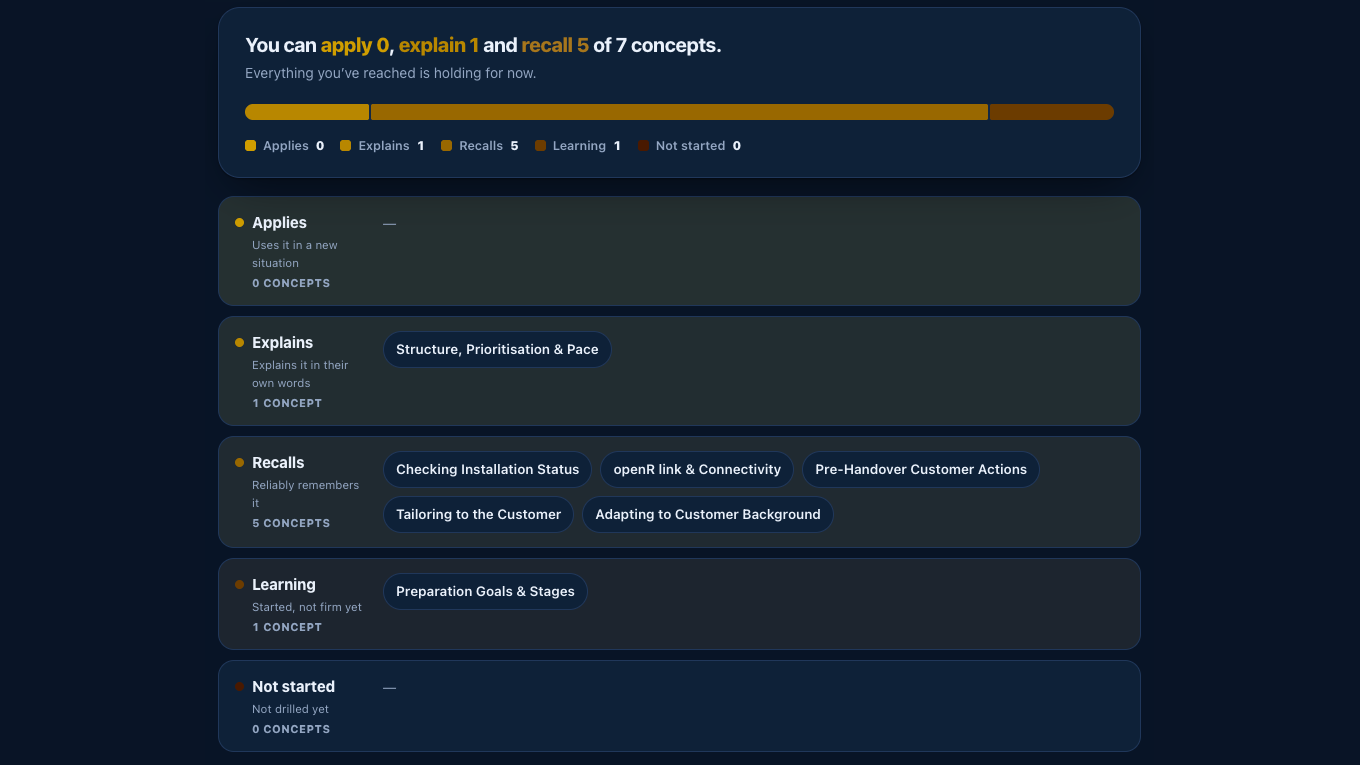
Wranx tracks three kinds instead of one. We call it the mastery ladder, and every individual concept a learner meets climbs it separately.
Recall, Explain, Apply
The three rungs are deliberately plain, because they describe things a manager can picture.
Recall is remembering it. Explain is being able to say why, in your own words. Apply is using it in a situation you have never been drilled on. A learner sits at a different rung on every concept in their programme, so somebody can be at Apply on the returns policy, Explain on the warranty terms and still at Recall on the new season range.
Underneath those three there are two more states worth naming, because reporting that pretends they do not exist tends to flatter itself. A concept nobody has seen yet is New. A concept somebody has started work on but not yet secured is Learning. Neither is a failure, and neither is counted as knowledge.
Take a returns policy, which is about as ordinary a piece of workplace knowledge as exists, and follow one concept up the ladder.
Recall: they remember it
At the bottom rung the question looks like the questions everybody already knows. Within how many days can a non sale item be returned with proof of purchase? Multiple choice, missing words, true or false. Short retrieval practice, repeated on a schedule, which is what moves a fact from "I have seen this" to "I know this" and then keeps it there.
Two things make this rung different from a quiz score.
The first is that one correct answer does not earn it. A learner has to get the point right several times, on separate days, before Recall is recorded. Answering the same question twice in one sitting proves the answer is still in short term memory, which nobody was in any doubt about.
The second is that how an answer was marked decides what it is allowed to prove. Some points are self rated, where the learner says how well they knew it and that rating becomes the grade. Nothing in that chain ever checks whether they were right, which is fine for keeping a schedule honest and useless as proof of anything more. A multiple choice question is at least a quarter guessable. A self rating is entirely declarable, so no number of them ever adds up to a higher rung.
Worth separating this from certainty based marking, which is a different mechanism and easy to confuse with it. That is where a learner stakes how sure they are and a confident mistake costs more than an admitted guess, and it runs in assessments rather than in the daily drills.
Most platforms stop here and call it mastery. It is a reasonable place to stop if what you need is a compliance record. It is a poor place to stop if what you need is somebody who can handle a customer.
Explain: they can say why
The second rung asks the learner to write. A customer asks why sale items are treated differently. Explain the policy in your own words.
A good answer sounds like this:
Sale items sit outside the 30 day goodwill window because they were sold at a reduction. That only affects our own returns policy though. The customer keeps every statutory right, so if the item is faulty we still take it back.
That answer is graded on the reasoning rather than on whether it contains the approved phrasing. Somebody who has memorised the wording of a policy and somebody who understands it produce very similar multiple choice results and noticeably different sentences, and this is the rung where the two come apart.
Because of that, Explain has a rule that surprises people the first time they hear it: a closed question cannot earn it at any volume. Not fifty of them, not five hundred. Explain is defined as putting the why or the how into your own words, and a question that offers you the words cannot demonstrate it. A learner's own rating of their answer cannot earn it either. Saying you understood something is not the same as showing it.
Apply: they can use it somewhere new
The top rung is the one worth reporting. No receipt, a bank statement, a sale item bought eleven months ago, and an angry customer. What do you do?
Nobody has drilled that combination, which is the point. Applying means meeting a situation you have not rehearsed and deciding correctly anyway. In practice that means scenario branching, judgement calls, and live roleplay with an AI customer who pushes back and changes their mind.
Recognising the right course of action in an unfamiliar situation genuinely is applying, so well built scenario questions can earn this rung too. They are priced rather than banned: it takes several of them, on separate days, where a single strong written answer or a strong recorded conversation will do it on its own. What never earns Apply, at any volume, is a learner's own rating of themselves.
This is the difference between somebody who passed the module and somebody you would put in front of a customer on a Saturday.
The ladder only goes up
Attainment in Wranx is monotonic, which is a dry way of saying that a bad day cannot take away something a learner has already proved.
Once a rung is earned it stays earned. A weak attempt afterwards does not demote anyone. There is no negative marking anywhere in the model, no points deducted, no rung lost because somebody rushed a drill in a car park between appointments. Mastery rises through demonstrated understanding and through nothing else.
That is a design decision rather than a kindness. A model that can punish you is a model people learn to game, and the moment a learner starts protecting their score instead of answering honestly, every number the platform produces stops meaning anything.
What fades, and what that means
Knowledge does decay, and pretending otherwise would make the ladder a record of what was once true rather than a picture of what is true now.
So each rung has its own clock, and the clocks run differently on purpose.
Recall is maintained by drilling, so it fades exactly when the spacing schedule says the concept is overdue. Explain and Apply are earned rather than maintained, so they fade against the age of the demonstration itself, on windows you set per programme. Some knowledge should never go stale, and a window can be set to zero so that it does not.
Fading never demotes anybody. A faded Explain is still an Explain, reported as slipping rather than lost, and it comes back around in the drill schedule before it becomes a problem. The distinction matters to whoever reads the dashboard: slipping is a nudge, and it is not the same signal as never having got there.
The bar is yours to set
Not every programme needs the top rung, and pretending otherwise wastes everybody's time.
Each module names the rung at which a concept counts as secured. A safety induction where recognition genuinely is enough can sit at Recall. A policy programme where people have to be able to explain themselves sits at Explain. Product and sales training, where the whole point is handling a conversation nobody scripted, sits at Apply.
Setting that bar honestly is worth more than setting it high. A programme that demands Apply on two hundred concepts is a programme nobody finishes.
What it changes on a Monday morning
The practical difference shows up in what a manager can ask for.
Instead of a completion rate, you get a count of who has reached which rung on which concept. Instead of "the team scored 78% on the returns module", you get "eleven of the fourteen can explain the sale item rule, four can apply it under pressure, and these two have never got past reciting it". One of those is a reporting line. The other is a list of names and a plan for the week.
It also changes what the platform does without being asked. A concept sitting at Recall when the programme needs Apply is a concept that keeps coming back, in a format designed to move it up rather than simply to test it again.
See it against your own material
The ladder is not a scoring theory we ask you to take on faith. It runs on your content, your concepts and your definition of what secured means.
You can read how the drills and the scheduling work on the training page, or book a demo and we will build a handful of concepts from material you already have, then show you what each rung looks like when a real person climbs it.
Bring the topic your team is most confident about. That is usually the interesting one.