Training tips that triumph
Memory science, microlearning and what actually makes workplace training stick.

How to Effectively Onboard New Staff: Your Guide to Success
Welcoming new staff members to your team is an exciting opportunity for growth and development. However, the onboarding process can make or break their initial experience with your organization. Effective onboarding is essential for setting the stage for long-term success, engagement, and productivity. In this blog post, we will explore the key steps and strategies you need to undertake to effectively onboard new staff smoothly, ensuring a smooth and impactful onboarding experience for your new hires. 1. Create a Structured Plan to Onboard New Staff A structured onboarding plan is the foundation of a successful onboarding process. Start by defining clear objectives and goals for the onboarding period. Break down the plan into manageable steps, considering both company-wide essentials and department-specific requirements. This plan will serve as a roadmap, ensuring consistency and providing a sense of direction for both the new hires and the onboarding team. Organizations with structured onboarding saw a 60% year-over-year improvement in revenue Northpass 2. Begin to Onboard New Staff Before Day One The onboarding process should start well before the new employee’s first day. Send a welcome email or package that includes relevant information, such as an employee handbook, company policies, and any

Successful employee onboarding: The science, benefits and tricks
Inductions for new starters can cover organization structure, HR procedures, health and safety, equipment overviews, job requirements, training and development programmes, meetings with colleagues and more. New starters can’t be expected to remember all of that in one go, though – our brains simply aren’t geared up for it. But, it’s important. Successful employee onboarding significantly improves employee morale, performance and retention, all of which have a positive effect on your organization’s bottom line. Despite that, organization onboarding processes typically take a traditional, classroom-based approach to learning, with information given to new starters in big chunks. This is down to time and cost pressures, of course, but it’s counterintuitive because it costs more time and money in the long run through a lack of effectiveness and efficiency. But how can we make sure the onboarding we deliver is effective? And what makes it effective?SCIENCEFor employee onboarding to be successful, new starters need to both take in and retain a large amount of information. We’ve known as far back as 1956 that we learn lots of info better when we break it up into small chunks. American psychologist George A. Miller termed this approach “chunking” and it’s the basis for what

5 Reasons Your Onboarding Isn’t Effective
Onboarding is an essential process for any organization, large or small. It helps ensure that new hires feel welcomed, valued, and equipped to do their job. However, despite its importance, onboarding doesn’t always work as it should. There are many reasons why onboarding can fall short, leaving new hires feeling lost, overwhelmed, and underprepared. In this blog post, we’ll explore five common reasons why onboarding doesn’t work and what you can do to fix it. Lack of Structure One of the most common reasons why onboarding falls short is a lack of structure. Onboarding should be a well-planned and structured process that covers all the essential aspects of the job, from training to company policies to goals and expectations. Without structure, new hires may feel disoriented and unsure of what’s expected of them, leading to decreased job satisfaction and productivity. To fix this, make sure your onboarding program has a clear structure and covers everything your new hires need to know. No Follow-Up Another reason why onboarding may not work is that there is no follow-up after the initial training period. Onboarding is an ongoing process that should continue beyond the first few weeks of employment. Regular check-ins with

Certainty Based Marking (CBM): Measuring Training Success
Creating effective learning is a continuous challenge for corporate businesses. The introduction of new technologies has eased this by opening up more ways for employees to take part in workplace training, such as e-learning platforms, video learning, and virtual reality. Formal training has vastly progressed over the years, but there is room for improvement through assessments, and that’s where Certainty Based Marking (CBM) can have a huge impact on training and development. Multiple-choice assessments remain the most common and convenient method of evaluation; scoring is quick and simple, multiple versions can be created and simple metrics highlight who knows the subject matter and who doesn’t. However, these traditional metrics aren’t completely reliable. They fail to demonstrate how training impacts the employees’ performance, their confidence, or how effectively knowledge is retained over time. Despite the convenience of multiple-choice assessments in terms of distribution and the metrics it provides, they are problematic. Multiple-choice assessments make it easier for the learner to guess the answer, rather than demonstrate that they know specific information. Multiple-choice also tests the learner’s ability to recall information, as opposed to showing that the learner understands the answer’s application in real-life situations. For example, a salesperson might be

Revamp sales training programs with microlearning
Did you know that 58% of buyers say that sales reps are unable to answer their questions? Do you have a way of tracking this at your organization? If not, it’s worth doing some research as you could potentially be slowing down, or worse, losing out on sales. The market has changed dramatically over the last 10 or so years. Now buyers have access to a lot more information about products and services on the internet, and as such, will spend time doing their research before making a purchasing decision. It’s therefore imperative that your sales team know your product like the back of their hand, so they can skillfully convert more sales. But with the average turnover rates for sales teams being around 34% and studies showing that 84% of sales training is forgotten after 3 months, staying on top of training is no mean feat. Companies should provide sales training on a regular to ensure their teams have up to date product and business knowledge. In this blog we’re exploring how often you should be running training sessions, the benefits of using online tools and how the Wranx platform can help. How often should you provide sales training?

The Surprising Impact of Emojis on Learning
As professionals, we often feel the pressure to communicate with increasing efficiency and speed. And in recent years, emojis have crept into our conversations, emails, and even work presentations. But while they may be seen as nothing more than a trendy communication tool, new research suggests that emojis can have a powerful impact on learning. As a manager, understanding this impact can profoundly benefit your team’s learning and development, productivity and engagement. Emojis boost memory retention Studies have found that incorporating emojis into training modules can increase memory recall by up to 80%. Emojis add interest and help form associations between concepts, making them more memorable. If you’re trying to train your team on a complex topic, try incorporating emojis into your materials to help them better remember important facts. Emojis humanize communication In any professional setting, building relationships is key to driving success. Emojis add a human element to communication that can make your team feel more connected and engaged with one another. By using emojis that relate to your team’s interests, recognizing successes, or even just adding a smiley face to your messages, you can break down barriers and create a more collaborative work environment.
Awarding Points using Certainty Based Marking
In today’s fast-paced professional world, evaluating skills and knowledge effectively is more important than ever. One innovative of assessment is certainty based marking (CBM), which takes into account not only the correctness of answers but also the confidence with which they are provided. In this blog post, we explore the key aspects of assigning points for CBM to ensure fair and robust results. So, stick around to learn how you can make the most of this assessment technique! What is Certainty Based Marking? CBM is an assessment method where learners assign a certainty level to their answers, typically on a scale of 1 to 3. The scoring system rewards correct answers provided with confidence and penalizes incorrect answers paired with high certainty. By incorporating certainty levels, CBM encourages critical thinking, self-assessment, and greater engagement from learners. Points Allocation for CBM To implement CBM effectively, it’s essential to determine the best way to allocate points for each combination of correctness and certainty levels. Here are some guidelines: Correct answer with high certainty: Award the highest points possible. Learners demonstrated both knowledge and confidence in their responses. Correct answer with moderate certainty: Award partial points. While the answer is correct, moderate certainty

Understanding the Benefits of Spaced Repetition
Learning a new skill or subject can be challenging, especially when you’re trying to memorize a lot of information. Spaced repetition is a learning technique that can help you remember more information in less time and with less effort. This method is based on the idea that the more frequently you review information, the more likely you are to retain it. In this blog post, we’ll take a closer look at what this training method is, how it works, and how you can get started using this technique to enhance your learning ability. Understanding Spaced Repetition Spaced repetition is a technique that involves gradually increasing the time between reviews of information. When you first learn a new concept, you might review it several times in a short period to ensure it sticks in your memory. Over time, as you become more comfortable with the material, you’ll review it less frequently, with longer gaps in between reviews. By spacing out your reviews in this manner, you’re more likely to remember the information long-term. Why Spaced Repetition Works The reason spaced repetition is effective is because it leverages advances in our understanding of how memory works. Our brains remember things better when

How inclusive training can boost employee morale and productivity
A diverse and inclusive workplace can help your business become more innovative, productive and profitable, with inclusive workplaces being 1.7 times more likely to lead their industries in innovation and 25% more likely to have above-average profitability. Statistics also show that inclusive workforces make better business decisions 87% of the time, leading their businesses to achieve 60% better performance results overall. Diversity refers to the make-up of your workforce: ensuring equal opportunities for all regardless of their background. Inclusivity goes beyond diverse hiring practices and team dynamics. Inclusivity is key to creating a positive workplace culture in which all employees feel comfortable, confident and valued. Happy employees are what help your business to thrive! Inclusion in the workplace can help your business function better at individual, team, and company levels. However, proper diversity and inclusion (D&I) training, as well as inclusive training practices, are essential to securing the benefits on offer.

Microlearning examples and best practices
Microlearning is a training technique that delivers relevant learning content in bite-sized units which can be accessed by the learner at their own convenience. Unlike traditional training methods, which can be passive, time consuming and dense with content, microlearning supports knowledge retention by offering learners shorter sessions that cover exactly what they need to know at exactly the right time. Microlearning is growing in popularity among businesses and learners as an alternative learning solution. In fact, 8 out of 10 learning & development professionals favour microlearning because their learners prefer it, and it has been shown to create up to 50% more engagement among users.

5 must-follow women in Learning & Development
Just over a week ago, the Women in Learning Conference took place – the first ever in the UK! The creation of the event stemmed from Donald H Taylor’s research in 2015, which highlighted the issues surrounding gender inequality in the learning sector.
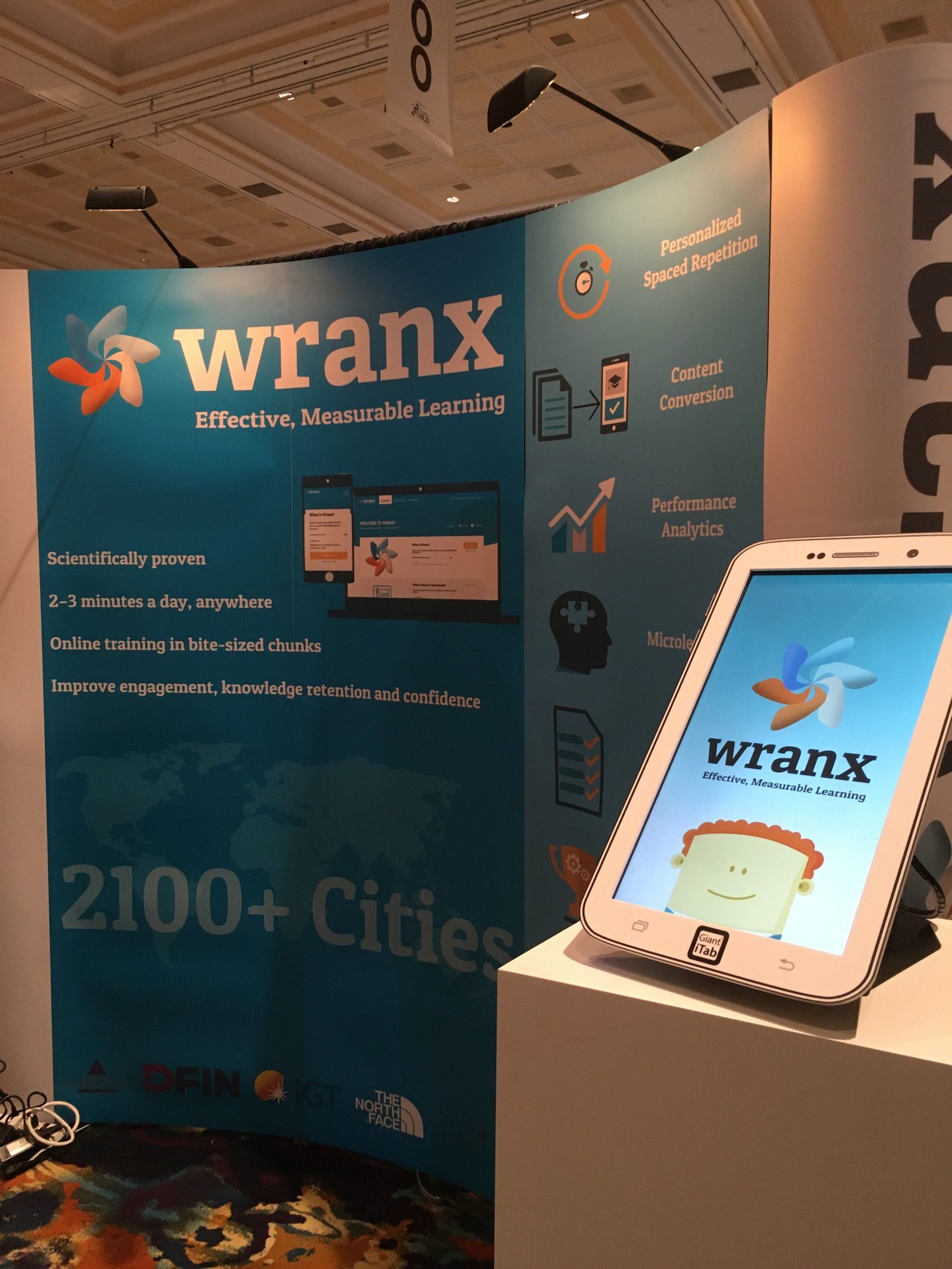
A look back at DevLearn 2019
It has been one week since the Wranx team exhibited at DevLearn in Las Vegas – an event dedicated to unearthing and showcasing future learning technologies. It was the team’s first time over in the US for an exhibition – what an experience! The event had over 150 exhibitors, over 3,500 attendees and more than
Reading about it is the easy part
See what daily retrieval practice looks like running on your own training content.