Skip to content
Wranx

The Surprising Impact of Emojis on Learning

Persia Shahkarami 3 min read Updated 13 February 2024

As professionals, we often feel the pressure to communicate with increasing efficiency and speed. And in recent years, emojis have crept into our conversations, emails, and even work presentations. But while they may be seen as nothing more than a trendy communication tool, new research suggests that emojis can have a powerful impact on learning. As a manager, understanding this impact can profoundly benefit your team’s learning and development, productivity and engagement.

Emojis boost memory retention

Studies have found that incorporating emojis into training modules can increase memory recall by up to 80%. Emojis add interest and help form associations between concepts, making them more memorable. If you’re trying to train your team on a complex topic, try incorporating emojis into your materials to help them better remember important facts.

Emojis humanize communication

In any professional setting, building relationships is key to driving success. Emojis add a human element to communication that can make your team feel more connected and engaged with one another. By using emojis that relate to your team’s interests, recognizing successes, or even just adding a smiley face to your messages, you can break down barriers and create a more collaborative work environment.

Emojis drive engagement

Engagement is a key factor in driving team productivity. And studies suggest that emojis can help increase engagement among team members. By using emojis in your communication, you create a lively and engaging conversation that is more likely to keep people’s attention. Consider using emojis in team meetings, presentations, or even in your training materials to keep your team engaged and motivated.

Emojis can improve productivity

In today’s fast-paced work environment, finding ways to improve productivity is crucial. When teams communicate effectively, they can reduce the amount of time spent on misunderstandings and miscommunications, leading to fewer errors and faster project completion. Incorporating emojis into your everyday communication is a fun and efficient way to facilitate team conversations that drive results.

Emojis build stronger relationships

Strong relationships are the cornerstone of any successful team. Including emojis in your communication can help teams connect on a deeper level. By using a meaningful emoji that aligns with the context of a message, receivers are more likely to feel understood, their success noticed, or their concerns validated. This can ultimately lead to stronger relationships, greater trust, and more successful collaborations.

Emojis may seem like an insignificant addition to your professional communication, but the research suggests otherwise – emojis can have a big impact on learning, communication, productivity, engagement, and relationships! As a manager, understanding this impact is crucial to ensuring your team’s success. By incorporating emojis into your everyday communication, you can build a more collaborative, connected, engaged, and productive team. And ultimately, this can drive better results for your business.

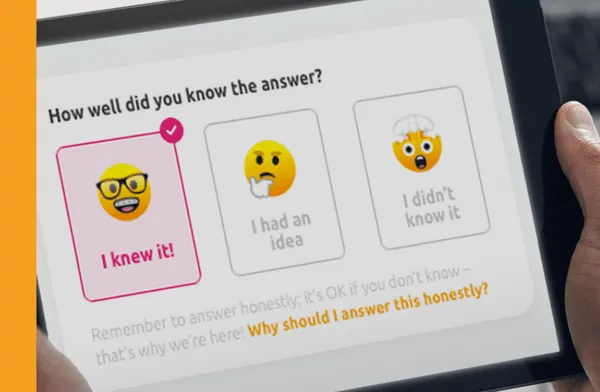
Wranx’s microlearning platform utilizes emojis throughout its app, covering everything from answering questions correctly ✅, certainty based marking 🤔, progress tracking 🔥 through to performance 🏆.

What is certainty based marking I hear you ask? Learn more here.

Tagged emojis Employee Training and Development Microlearning Staff Training
Keep reading

More on this

Microlearning

Unlock AI’s Potential for Employee Upskilling and Reskilling

The landscape of work is transforming at an unprecedented rate, demanding that businesses adapt by continually enhancing the skills of their workforce. This challenge requires innovative approaches, and artificial intelligence (AI) stands out as a key enabler. In this article, we explore how AI can revolutionize the upskilling and reskilling of employees, ensuring that your

6 min read
Microlearning

Certainty Based Marking (CBM): Measuring Training Success

Creating effective learning is a continuous challenge for corporate businesses. The introduction of new technologies has eased this by opening up more ways for employees to take part in workplace training, such as e-learning platforms, video learning, and virtual reality. Formal training has vastly progressed over the years, but there is room for improvement through assessments, and that’s where Certainty Based Marking (CBM) can have a huge impact on training and development. Multiple-choice assessments remain the most common and convenient method of evaluation; scoring is quick and simple, multiple versions can be created and simple metrics highlight who knows the subject matter and who doesn’t. However, these traditional metrics aren’t completely reliable. They fail to demonstrate how training impacts the employees’ performance, their confidence, or how effectively knowledge is retained over time. Despite the convenience of multiple-choice assessments in terms of distribution and the metrics it provides, they are problematic. Multiple-choice assessments make it easier for the learner to guess the answer, rather than demonstrate that they know specific information. Multiple-choice also tests the learner’s ability to recall information, as opposed to showing that the learner understands the answer’s application in real-life situations. For example, a salesperson might be

8 min read
Microlearning

How can eLearning contribute to employee training and development?

With the widespread availability of the internet across various devices, web-based e-learning has become easily accessible. This connectivity allows teachers and learners worldwide to engage regardless of their location. This connectivity is particularly advantageous for businesses, enabling them to gauge performance across different company sites and against global standards. For those interested, our e-learning guide on the future of employee knowledge is just a click away. So, what does this mean for employee development? Cost-Efficiency By integrating strength training into a runner’s routine, they can sustain improved speed and performance over time. E-learning eliminates the need for traditional classroom setups, reducing training costs significantly. It not only eliminates the expenses associated with in-person training but also allows content to be easily replicated for diverse learners on various devices. Concentrating on e-learning for learning and development investments can lead to long-term cost savings. Convenience E-learning offers a more convenient learning experience, with the classroom accessible online. Learners have the flexibility to choose when and where they learn, tailoring the process to their preferred learning style. This increased convenience enhances the efficiency and effectiveness of a company’s training and development strategy. In essence, e-learning accelerates employee learning. Enhanced Knowledge Retention A blended

2 min read

See it working on your own content

Request a demo and we’ll build a drill from something your teams already train on.