Training tips that triumph
Memory science, microlearning and what actually makes workplace training stick.
Infographic: How to prepare your workforce for the future
Moving towards the future, corporate businesses are witnessing how quickly the work environment is evolving and the implementation of new technologies that are improving the way they operate and learn.
Infographic: Measuring improved performance with assessments
Organisations spend a lot of time and budget training their employees in a variety of fields, including compulsory training such as compliance or health and safety, and specific areas such as sales and product knowledge. Commonly, training involves assessment to confirm whether the information has been successfully learnt by employees and can be applied in the workplace.

Is ‘Engagement’ the elephant in the room?
The issue of employee engagement has been a popular conversation in recent years in the Learning and Development community, as employers are constantly seeking new ways to improve commitment in the workplace. The 2017 Trends in Global Employee Engagement Report, which covered more than five million employees at over 1,000 organisations around the world, showed that less than one quarter of employees are highly engaged and in a single year, employee engagement globally dropped from 65% in 2015 to 63% in 2016.

It’s not just Spaced Repetition with Wranx – It’s personal
It’s interesting how some people you know have the most remarkable memory. But how are they able to retain so much information and recall with ease? It is a focus of ours at Wranx to improve knowledge retention, through the innovative method of Spaced Repetition. However, we have developed it further and made Spaced Repetition on our platform personalised.

Make learning easier with the Wranx mobile app for Android and iOS
Following our introduction of Certainty Based Marking to the Wranx platform, we’re pleased to say that the platform is now available as a mobile app for both Android and iOS. If you’ve used the mobile version of our website, the Wranx mobile app will look very familiar. There are a number of new features that have been included to improve the learning experience too, though. Perhaps the most useful feature is push notification functionality, which is used to encourage learning. Notifications are sent to learners who have not logged in for three or more days, to learners with a Seinfeld Chain of over five days learning and to users who have a Spaced Repetition question scheduled, with a truncated question shown to encourage the learner to log in and answer. Notifications are sent at times, intervals and locations that are appropriate to learners. They’re not sent over weekends, for example, but when learners are in work. Reminders for Users who haven’t logged in for a few days or more are sent early in the day to give them plenty of time to fit learning in that day. Chain reminders are sent towards the end of the day, meanwhile, to give

Measure employee learning performance effectively with Wranx Analytics
Part of what can make Wranx so powerful for organisations are the learning principles on which it is based, like Spaced Repetition and Certainty Based Marking (CBM). To make the most of our – or any – platform, though, you need to understand the impact it is having and be able to measure employee learning, which is why we’ve rolled out our new, in-built analytics platform.

Measure training effectiveness for sales
An interview with Deborah Bees, Matrix

Meeting customer and regulatory expectations in contact centres
Like any business, contact centres have specific regulations and expectations to adhere to, from both a legal and a customer service perspective.
Microlearning: The benefits of bitesize
As modern workplaces become busier and increasingly reliant on technology, our attention spans are growing shorter. In fact, the average human attention span is now shorter than a goldfish’s! As a result, many of us are seeking out content that is brief and easily digestible in both our professional and personal lives.

Enhancing Safety Through Play: The Gamification of Health and Safety Training.
Regardless of an organisation’s size and sector, health and safety training is an essential activity. Providing staff with greater expertise and knowledge is arguably more important for those involved in higher risk industries. As an employer, it is your responsibility to provide information, instruction and training wherever possible to ensure the workforce remains free from harm. Traditional training methods such as classroom-based teaching are not particularly well suited to organisations that need to prioritise health and safety. Members of staff often struggle for motivation, while the business itself must find the time and resources to implement employee training More and more businesses, therefore, are looking at different training approaches, such as gamification. While some employers may consider workplace fun to be counterintuitive when culturing a safe environment, gamification combines the need for training with more interesting and engaging learning materials. When it comes to health and safety training, most organisations will formulate a plan that relates to the skills and knowledge needed to avoid accident and injury. This can involve looking at previous instances of workplace injury, near misses, or cases of ill health to learn lessons and gain greater insight into the risks that exist. When this process is

Retail staff training: How to get new employees up to speed
Retail staff are the face of your business. They determine whether a customer has a positive in-store experience, resulting in customer satisfaction, or a negative one, leading to customer churn. Therefore, it’s important that new employees can get up to speed with company procedures and product knowledge in order to provide the best customer experience.
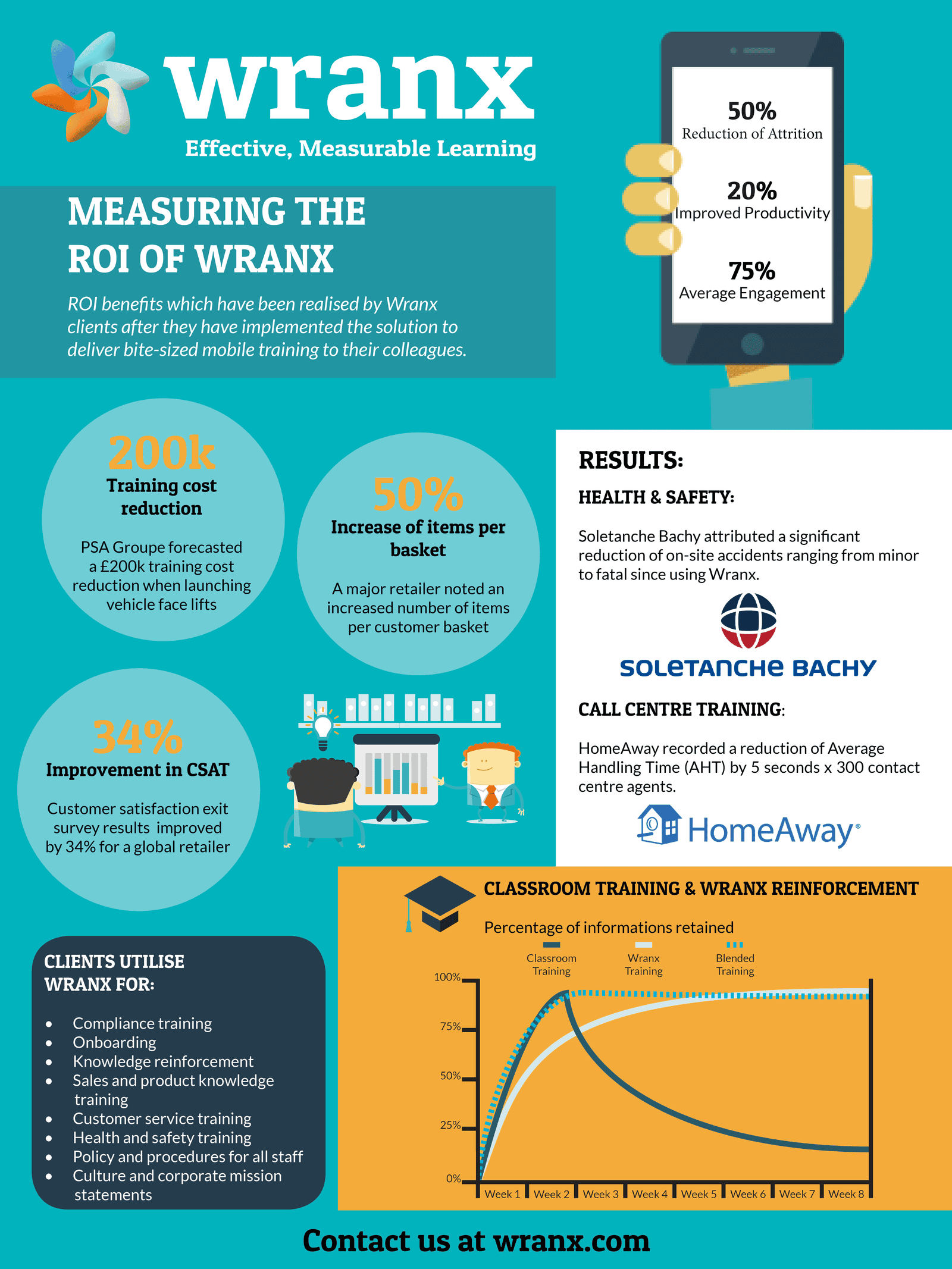
Return on investment: make learning rewarding
Calculating the return on investment for training can be challenging as the benefits and outcomes can be difficult to measure. Training can be a significant investment for any organisation when all the factors and associated costs are calculated. So it’s important when requesting a budget to deliver any kind of training that you can demonstrate a healthy and measurable return on investment.
Reading about it is the easy part
See what daily retrieval practice looks like running on your own training content.